


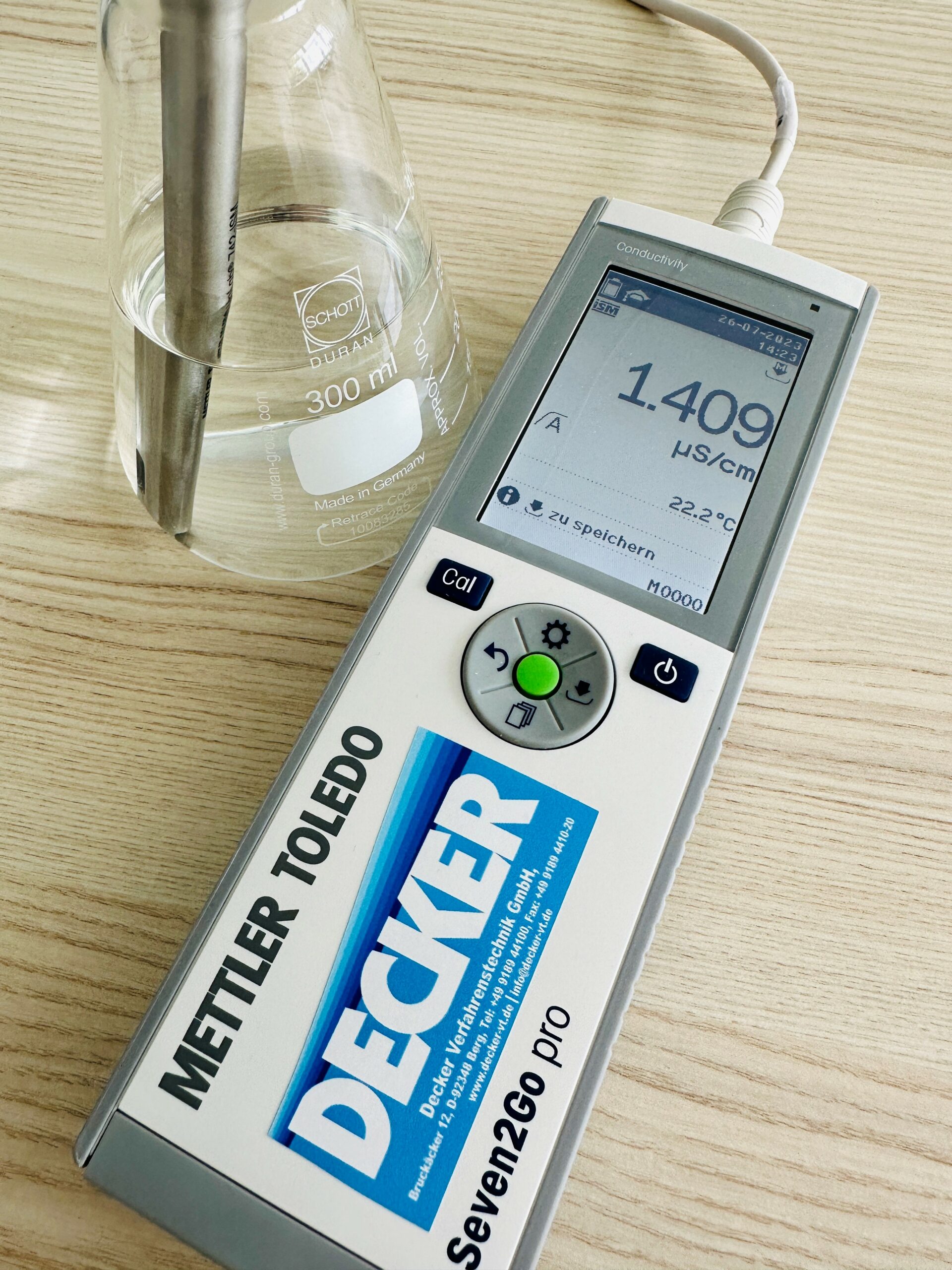
VE water
VE water is the abbreviation for demineralized water or deionized water or DI water. This is water whose ionogenic components have largely been removed beforehand, so it is almost pure H2O, apart from a few trace substances. Externally, it does not differ from tap water, but in particular it does not form any deposits (e.g. lime) during evaporation or vaporization. However, this does not say anything more about the exact quality or the process of producing the deionized water, because this is determined by the intended use of the deionized water, which is typically summarized in the sum parameter conductance in µS/cm, for high-purity ultrapure water applications, i.e. ultrapure water applications in MΩ-cm (typically at the reference temperature of 25°C).
Some typical guide values for deionized water in the respective sectors:
- Comparison of city water ~ 500 µS/cm (maximum according to Drinking Water Ordinance: 2790 µS/cm)
- Hot-dip galvanizing < 50 µS/cm
- Anodised< 30 µS/cm
- Forklift water or battery water during filling: < 30 µS/cm
- Electroplating < 20 µS/cm
- Hard chrome plating < 3 µS/cm
- Hydrogen production < 0.25 µS/cm (so-called ultrapure water)
- Semiconductor < 0.1 µS/cm (0.06 µS/cm) (so-called ultrapure water)
In addition to the sum parameter conductance in µS/cm or MΩ-cm, other parameters may also need to be taken into account, such as COD/BOD or, in particular, silicic acid/silicates, which are not visible in the conductance but can also form poorly soluble deposits that can only be chemically removed with hot caustic soda or hydrofluoric acid.
Depending on the process engineering system, the quality of the conductance of the deionized water to be achieved can be determined. There are two main methods: Full demineralization by ion exchanger (e.g. via a so-called full demineralization system or VE-system with separate cation exchanger and anion exchanger or via a full demineralization cartridge (so-called VE-cartridge) with mixed bed resin for external regeneration or full demineralization by reverse osmosis system .
Both processes, ion exchanger and reverse osmosis, provide high-quality deionized water, possibly (at least with a permeate-staged reverse osmosis) even with a similar conductance of ~ 3-5 µS/cm, but the composition differs considerably due to the different function of the ion exchanger and reverse osmosis system. The ion exchanger (e.g. in a demineralization cartridge or a demineralization system) removes ions from the water based on the charge, the reverse osmosis system based on the size. In simple terms, it can be said that reverse osmosis separates everything that reaches a certain size like a broadband, whereas ion exchangers mainly separate the higher selective ions.
In the overall view however, this must be well assessed, as the regeneration of ion exchangers on site requires an industrial chemical-physical wastewater system, whereas the discharge of reverse osmosis concentrate generally does not, but does require larger quantities of water. An exemplary operating cost calculation shows the differences in the costs of the two methods. In any case, a permit for indirect discharge is also required for process water treatment from a volume of 10 m³/week, in some cases even below this limit. An indirect discharger permit is in any case required for the wastewater treatment of demineralized water that has been in operational use in a chemical-physical wastewater treatment system.
In terms of quality, the combination of ion exchangers and reverse osmosis systems, possibly in combination with electrodeionization and a mixed-bed Polisher demineralization cartridge, is a proven technique for achieving the lowest possible conductance values of 0.056 µS/cm or 18.18 MΩ-cm (at 25°C).
As a final alternative, demineralized water can also be purchased as an IBC, but this is usually the most expensive alternative.
Do you need demineralized water in your company? Please feel free to contact us.