


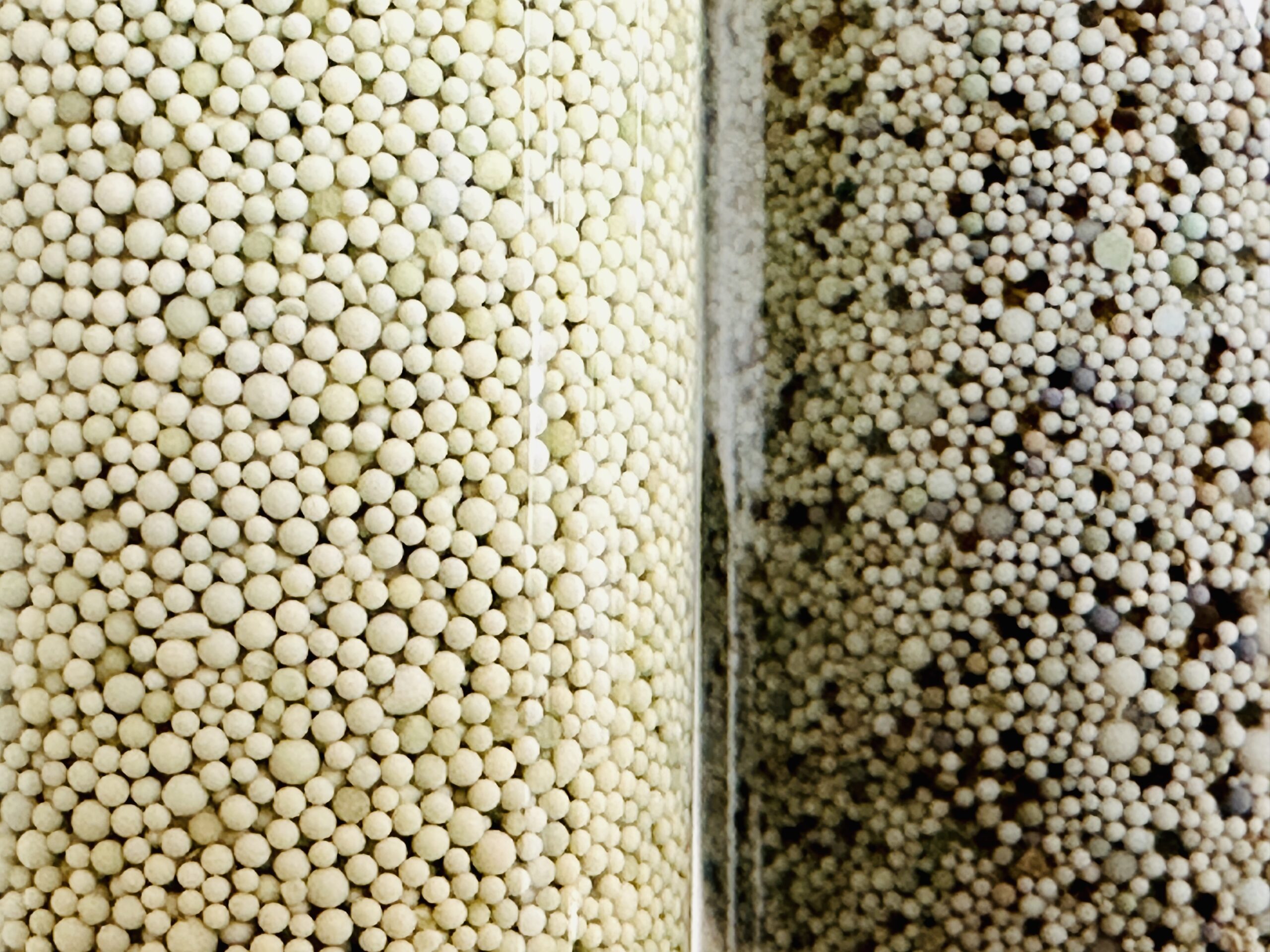
Ion exchanger function
The ion exchanger function is not like a filter on which new material constantly accumulates until it is completely blocked. Instead, an ion exchanger has the function of behaving like a “selective dam”, so-called ion exchanger selectivity. This means that, depending on the type of ion exchanger, it binds some elements rather than others, the so-called selectivity series. This even goes so far that some elements are not bound at all (e.g. anions in the cation exchanger; whereas cations in the anion exchanger can still be bound via a chlorine complex at a certain pH value).
To put it simply: in comparison, the dam of a beaver: very small components in the water, i.e. the low-selective components in the ion exchanger, pass through the dam, while all larger components, i.e. the higher-selective components in the ion exchanger, remain on the dam.
If the ion exchanger is now operated further, its behavior changes from a selective dam to an automatic sorting machine. Elements in the inlet that are higher selective displace elements that are lower selective. So if the ion exchanger, e.g. a strongly acidic cation exchanger in the H+ form (hydrochloric acid regeneration), receives copper, magnesium and sodium in the inlet, it will not stop binding them at the end of its capacity, i.e. when the ion exchanger is exhausted, but will want to continue binding them. However, as there is no more free capacity, there is competition between the less selective elements that are already bound, in this case sodium. Accordingly, the exchanger would continue to absorb copper and magnesium, but not sodium; on the contrary, it would release even more of the previously bound sodium for the copper and magnesium still bound. This means that at this point the outlet of the ion exchanger contains more sodium than the inlet, the ion exchanger is therefore overrun. This is the case until there is no more sodium on the exchanger and is then carried out in the same way with the magnesium until there is no more magnesium and the exchanger is completely loaded with copper. Only at this point the selective dam ion exchanger is actually “full” and the inflow corresponds to the outflow.
Waiting for this last point “full” is generally not very useful, because in the meantime undesirable substances have often already been released back into the actual stream to be cleaned, e.g. corrosive chlorides or silicates forming deposits in a mixed bed exchanger. For ion exchangers it is therefore generally advisable to connect at least two exchangers in series and to monitor the capacity of the first exchanger and regenerate it at the first sign. In practice, this means that the conductance of the demineralized water in µS/cm is often used as an indicator. When the conductivity value first rises above the usual value (e.g. 4-5 µS/cm instead of the usual 1-2 µS/cm) of the ion exchanger, an ion exchanger regeneration is advisable. In some applications, e.g. in a selective exchanger in a chemical-physical wastewater treatment system, the conductance is not available as an indicator, so analytical monitoring of the wastewater flow is usually carried out to determine a cycle according to which the ion exchanger is to be regenerated. There are also other applications in which the ionogenic substances are so firmly bound to the ion exchanger that they can no longer be regenerated (at least economically); in these cases or at the end of the ion exchanger’s service life, an ion exchanger change is required.
An ion exchanger also has specific properties that should be taken into account when using and planning the ion exchanger. Under certain circumstances, the ion exchanger can also emit a specific ion exchanger odour, even into the produced medium.
Do you have further questions about the function of an ion exchanger?
Please feel free to contact us.