


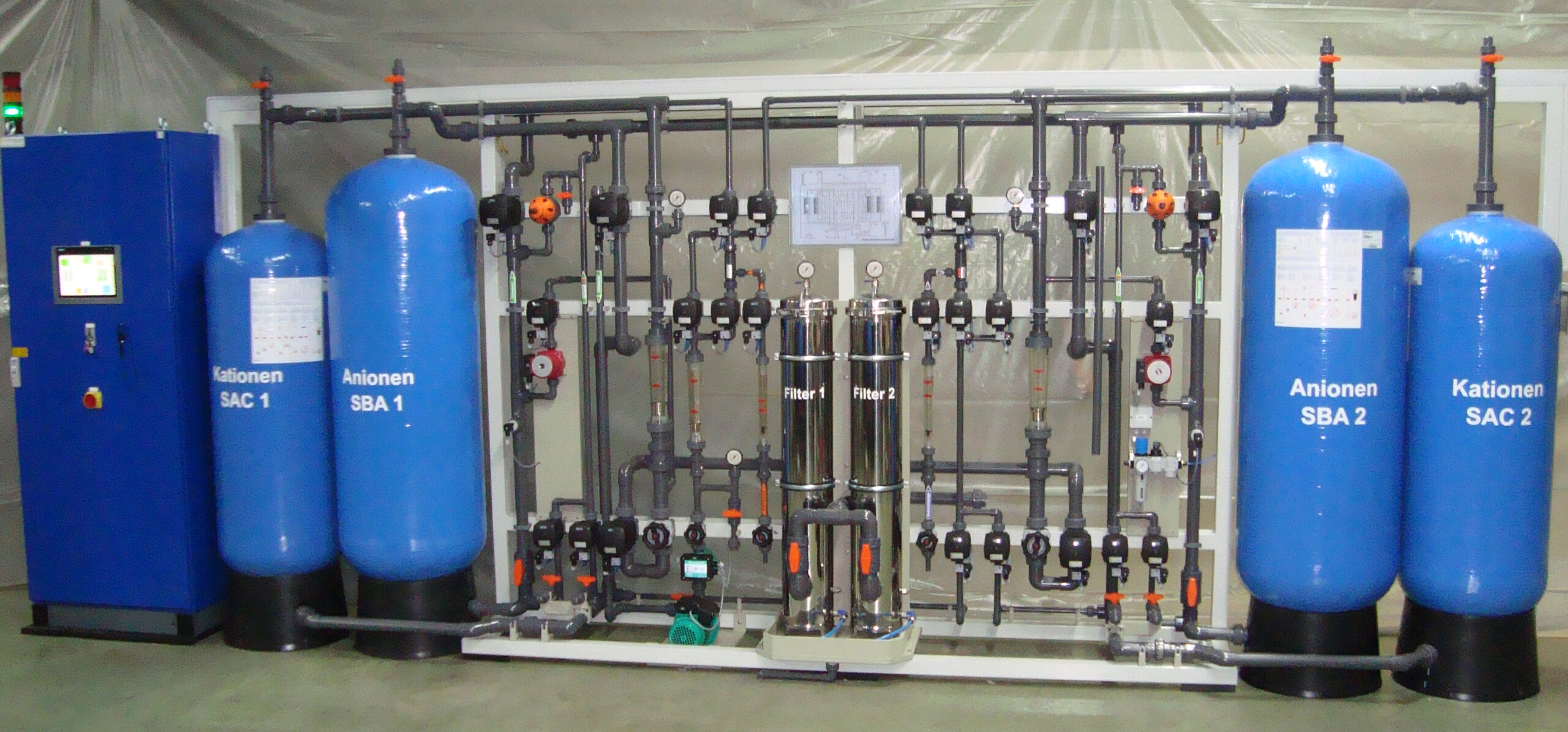
Demineralization system (VE system) Planning
When planning a demineralization system, a distinction must first be made according to the feed used to produce the desired demineralized water. Typically, city water from the municipal water supply is used in accordance with the Drinking Water Ordinance, but well water, groundwater or bank filtrate may also be suitable as a feed, although further pre-purification stages may be necessary here. Depending on the application, it may be necessary to connect a pressure booster station upstream, but this is rare in the municipal water sector.
In the Demineralization system planning, a system separator and a 100µm pre-filtration are carried out first to pre-clean any suspended solids and prevent water from being pressed back into the municipal drinking water supply. If no safety measures against chlorine are required, further filtration is provided and then the actual demineralization system. A distinction is made between a simplex system and a duplex system, depending on the load on the feed and the desired removal times and duration. The Simplex system is usually designed in such a way that it supplies the required water for at least one shift in 1-shift operation and then regenerates or that the regeneration time of approx. 3 hours is bridged via a storage tank. The duplex system, i.e. two parallel system lines, is designed for 24/7 operation and should also cover the required demineralized water demand for the duration of maintenance. Any longer bridging times, e.g. in the event of a defect or maintenance, can also be bridged with rental ion exchanger modules (e.g. up to 30-1000 L resin per module ~ 2-80 m³ demineralized water) for external ion exchanger regeneration
The complexity of the actual system is determined by the desired conductance and the budget or the operator’s requirements. As a rule strongly acidic cation exchangers and strongly basic anion exchangers are used (conductance usually <20 µS/cm, typically 1-3 µS/cm), but up to 4 different ion exchanger types may also be required as well as a membrane deaerator and additional external mixed bed filter (demineralization cartridge) or electrodeionization (EDI) to achieve the lowest conductance down to ultrapure water of < 0.1 µS/cm. Depending on the requirements and feed, further process engineering stages may also be necessary, such as sterile filtration and UV sterilization or separate separation of iron/manganese.
The demineralization system generates a so-called eluate or regenerate within the scope of the regeneration process. This is an acidic or alkaline wastewater flow of the ions bound during operation, which generally requires at least neutralization and possibly even chemical-physical wastewater treatment with precipitation. If an industrial chemical-physical wastewater treatment system is already on site, a demineralization system is often useful.
If there is no industrial chemical-physical wastewater treatment on site, an industrial reverse osmosis systemwith (usually) wastewater that does not require treatment (concentrate or regenerate from the softening system) often makes more sense. However, this does not apply to every constellation, as monitoring values below the exemption limit of 10 m³/week may also have to be complied with if the municipal water feed has a composition that is permissible under the Drinking Water Ordinance but must not simply be discharged. However, such problems are clarified as part of the design, if necessary also subsequently if the system already exists.
Do you have further questions about the planning, design, maintenance or operation of an ion exchanger system? Please do not hesitate to contact us.