


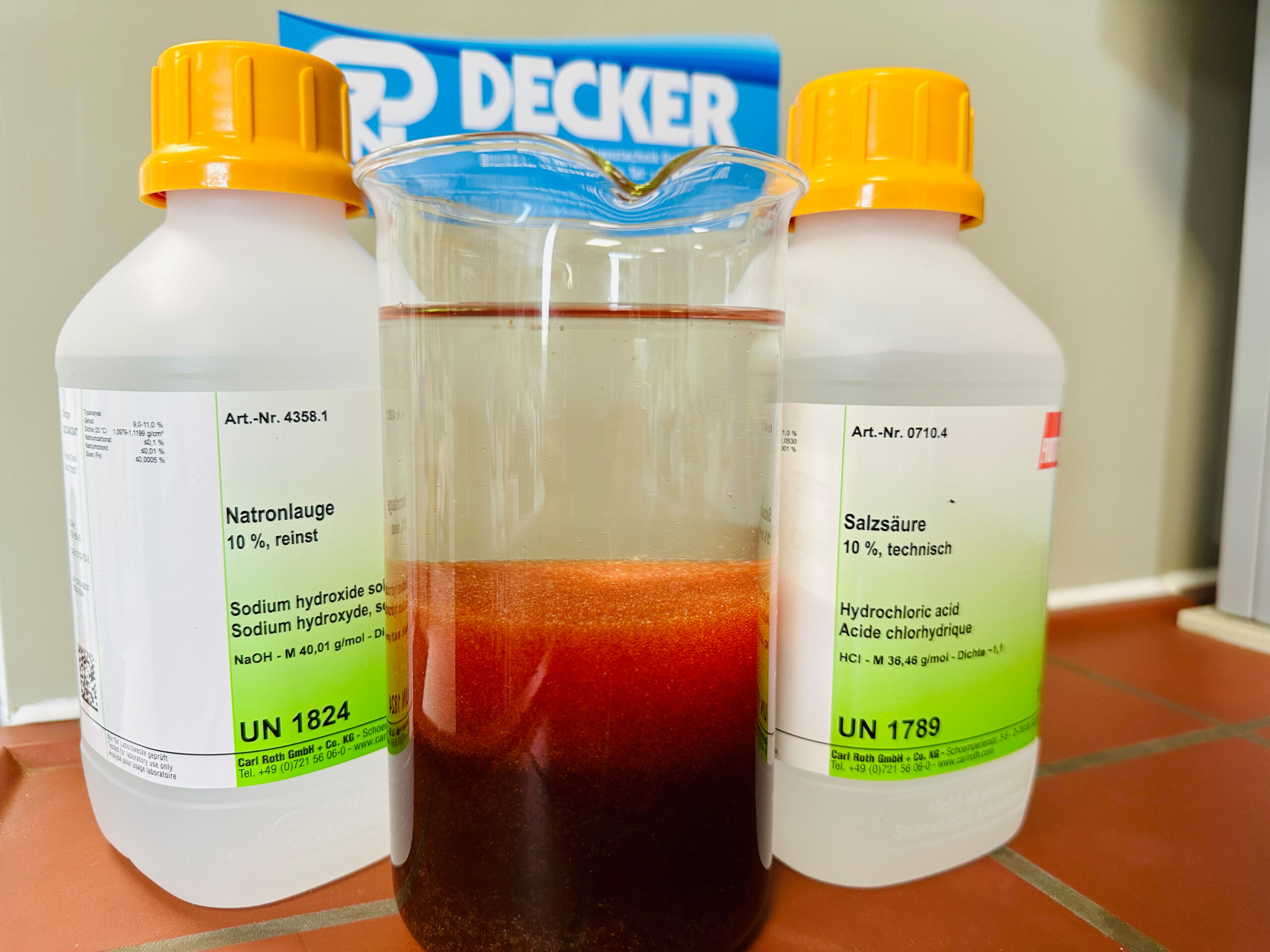
Instruction for ion exchanger regeneration
Ion exchanger regeneration instructions initially depend on the type and loading of the ion exchanger (e.g. ion exchanger from the demineralization cartridge or demineralization system, recirculation of rinsing water, selective exchanger from chemical-physical wastewater treatment or groundwater remediation). Basically, regeneration is carried out with a strong acid, usually 8% hydrochloric acid HCl (usually not sulphuric acid), or a strong base, usually 6% caustic soda NaOH (each percentage by weight). The exact manufacturer-independent framework conditions for standard applications for strongly acidic cation exchangers can be found, for example, in the Lewatit SP112 product data sheet, the exact data for anion exchangers in the Lewatit MP800 product data sheet and the data for selective exchangers in the Lewatit TP207 product data sheet. Experience has shown that these data should be given a “min.” should be added. Regeneration is monitored by titration. Mixed bed ion exchangers (e.g. from a demineralization cartridge) are usually first separated for regeneration and then the individual fractions are regenerated separately (see below).
The chemistry or the regenerate must then be washed out with demineralized water and the ion exchanger then (if necessary) converted into the form required for the specific application, so-called conditioning (mixed bed for demineralized water production not, selective exchanger, however, in the workable form (usually mono-Na)) and usually rinsed again with demineralized water. A distinction is usually made between 3 washing phases:
- Chemistry Displacement (0.5 – 2 BV (bed volume = resin to be regenerated in L))
- Slow washing (2-5 BV depending on resin type)
- Quick wash/circulation wash (2-5 BV depending on resin type)
Circuit washing is carried out either via external ion exchangers or via the ion exchangers themselves, if they are cation exchangers and anion exchangers in series. However, this already leads to partial loading.
There are special cases where further chemical steps are required, depending on the load and resin type.
Please note, however, that legal and chemical requirements must be met during the work steps:
- Special applications also require special framework conditions, which must also be considered. Depending on the complexity of the application, up to 3-stage regenerations are required.
- Wastewater requiring treatment is produced, which must not be discharged into the sewerage system without proper chemical-physical treatment. In some commercial applications, a permit or at least an official notification is required. In mixed-bed applications, for example, copper is often a heavy metal from the municipal water supply (permitted in drinking water up to 2.0 mg/L according to the Drinking Water Ordinance), which can easily exceed the typical monitoring value of 1.0 mg/l in reclaimed water for non-commercial discharges according to locally applicable drainage regulations and can therefore constitute an administrative offense. Incidentally, the most problematic parameter on the anion side is sulphate, i.e. it is not permissible at every location to carry out such a discharge, even in a private context, as the monitoring value is regularly 600 mg/l.
- Trimethylamine is formed during the regeneration of anion exchangers (also from mixed bed applications for demineralization).
- Ion exchangers have special framework conditions for use and regeneration that must be observed
- They work with corrosive acids and alkalis, which have special requirements for storage and handling, e.g. drip pans or WHG safety zones, occupational safety.
We therefore recommend in all cases (e.g. also for mixed bed resin from demineralization in small quantities): it is more advantageous to have the ion exchangers from the ion exchanger cartridges regenerated externally in a large system as an ion exchanger service.
In addition to the improved technical possibilities, such as separation of components due to different densities and separate extraction options for fractions, there is also the possibility of continuous visual inspection of the resin bed. This makes it easier to remove soiling and the regeneration process is continuously monitored.
If necessary, as with mixed bed resin, different components of the demineralization cartridge, i.e. cation exchanger and anion exchanger, can be separated from each other and regenerated in separate columns, so-called dual-column regeneration. This prevents the formation of dead zones or cross-contamination or pre-loading by regeneration agents, as it is the case with single-column regeneration. For smaller quantities of the same application, the ion exchangers from the different ion exchanger cartridges are mixed together in this process. In order to ensure consistent quality, a compensatory quantity of new resin is added due to resin ageing, especially of the anion exchanger. The customer shall receive the proportion of his input from the total quantity accordingly. If this is undesirable for quality assurance reasons, there is also the possibility of a “closed pool” regeneration of the ion exchangers, as is typically the case with the Ultra Pure Water (UPW) use of special mixed bed resins for the mixed bed polisher application after e.g. electrodeionization.
After regeneration, any necessary conditioning for the customer-specific process is carried out, e.g. for cation exchangers: H form, Na form, Ca form, K form, NH4 form, Fe3+ or Al3+ form or for anion exchangers: (pre-purified) OH form, NH3 form or Cl form.
The actual duration of regeneration usually only lasts a few hours. Including all ancillary activities, we guarantee a regeneration cycle of 2 weeks; in cases announced in advance, we can shorten this to 1-2 days or, in exceptional cases, to same-day.
Ion exchanger cartridges can be shipped emptied of residual water without any problems by a forwarding agent or via one of our optional delivery tours (4/8 weeks). We offer ion exchanger regeneration services particularly in German-speaking countries such as Germany, Austria, Switzerland and Italy, but also in English-speaking countries within and outside the EU.
For a quote for external ion exchanger regeneration, we need the following data from you
- Which resin do you use?
- Which application / load is involved?
- What quantity is involved?
We would be happy to send you an offer. Please feel free to contact us.