


What is an ion exchanger simply explained
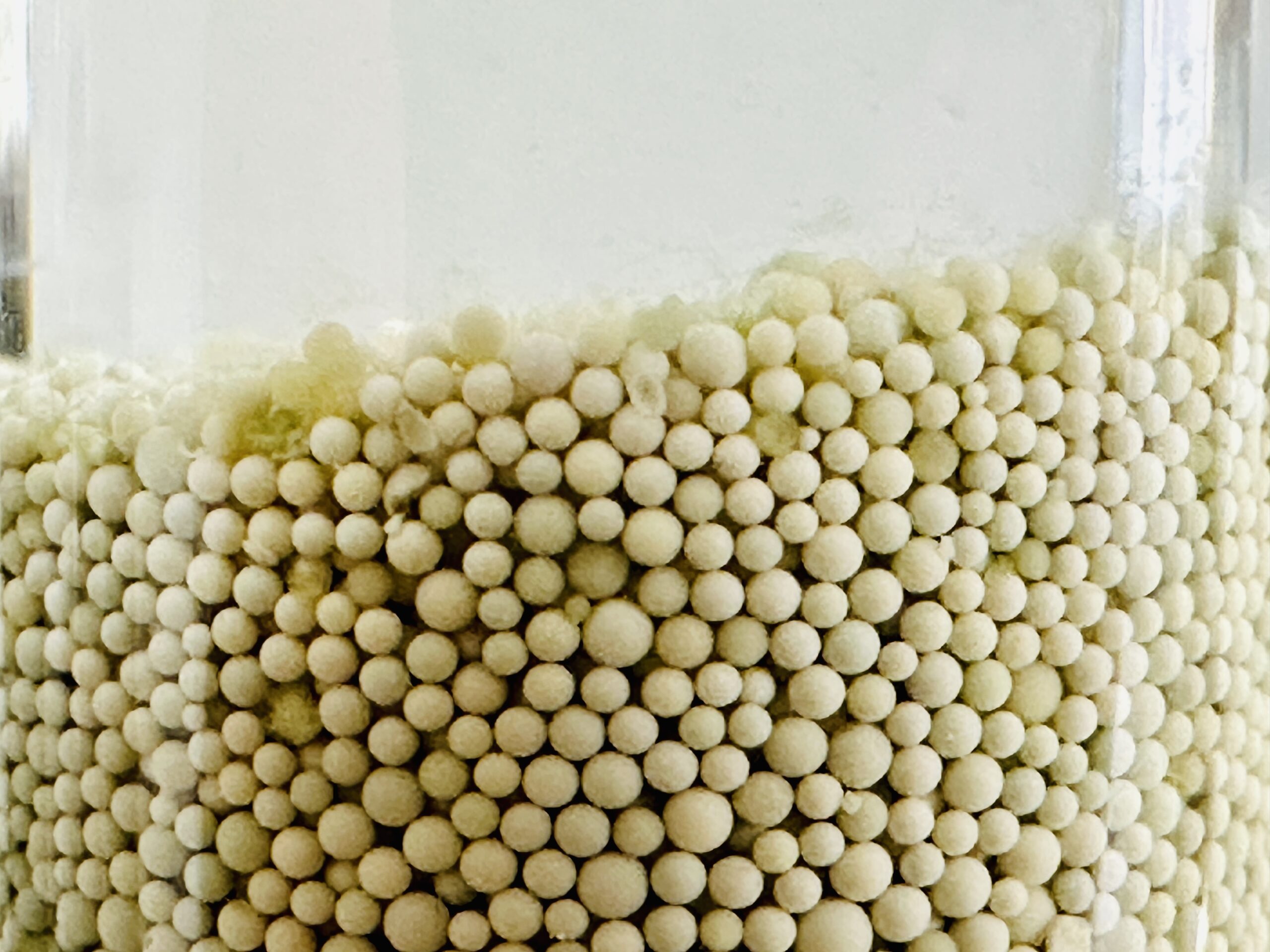
Simply explained, an ion exchanger is usually in the form of an ion exchange resin (but it is also available as a membrane). At first glance, an ion exchanger as ion exchange resin looks and feels like sand (approx. 0.2-0.8 mm). It should be noted that ion exchangers scattered on the floor are very slippery. Although the ion exchangers are chemically very stable, they should never come into contact with oxidizing substances (e.g. household cleaners), as this causes an exothermic (i.e. hot), outgassing reaction that can even lead to an explosion. In the course of a loading-regeneration operating cycle, a single resin ball changes its volume by up to 100% (can therefore become twice as large), if it dries completely by up to -50% (becomes half as small) and develops forces to burst steel tanks. If ion exchangers are filled into closed containers, it must therefore be ensured that the resins are always humid and that there is always sufficient free space to absorb the swelling. Under no circumstances should resins be replaced “at sight” if the condition of the resins is not known, as otherwise a tank (so-called ion exchanger cartridge) may explode in the event of swelling. In addition, the product and safety data sheet for the specific ion exchanger must be observed in particular, as well as our general information on ion exchangers.
Functionality
First of all, the ion exchanger is not a filter. Although it can act as a filter if it is operated from top to bottom, in so-called fixed-bed mode, this is generally undesirable. Therefore, impurities (particles, grease, oils, heavy biological contamination …) must be removed in advance by a filter.
The ion exchanger is defined by its mode of operation: under certain conditions, it exchanges ions in the inlet water for other ions that it already carries, and also – under other conditions – back again. As intended, the ion exchanger only works against polar substances, i.e. the cation exchanger can remove cations, the anion exchanger generally only removes anions. So we are talking about small ions that are not visible in the water (except for colorations, e.g. copper usually blue, chromate usually yellow). Simply explained, the bonds on the ion exchanger, or its “docking stations”, the so-called functional group, are subject to a certain sequence, the so-called ion exchanger selectivity. Furthermore, the binding behavior of the ion exchanger is influenced by the pre-treatment (so-called conditioning or activation), the pH value and the temperature and is modified accordingly depending on the substances to be bound. There are therefore “good” conditions for the binding of ions and “good” conditions for the subsequent release, which must be separated from each other. The ion exchanger has a limited capacity, i.e. within this framework it can still work and exchange all the ions corresponding to its functional group from the feed against its preload, after that it is exhausted. This can be seen in demineralization, e.g. in the conductivity, as soon as this rises even slightly, the ion exchanger must be regenerated, i.e. returned to its original state. If it is not regenerated in time, it is overrun. In contrast to a filter, which simply does not allow any more water to pass through when it is overrun, in demineralization you only notice this via the conductance of the demineralized water to be produced, in the selective exchanger in chemical-physical wastewater treatment analytically. In the overrun condition, the ion exchanger continues to work, i.e. according to its selectivity series, it now releases the weakest bound substances that it previously found. These are usually the substances on the far right of the selectivity series.
ion exchanger regeneration,
Ion exchangers are generally reusable “regenerable” and only need to be replaced with new ion exchangers in rare exceptional cases, e.g. if the bond between the bound ions is so strong that it can no longer be released during regeneration or if it has been damaged during operation by impurities (e.g. oxidative media), so-called Ion exchanger replacement or at the end of the ion exchanger service life. The reuse of the same ion exchanger is generally possible after the so-called ion exchanger regeneration. This can also be carried out in the central regeneration station for mixed bed resin and selective exchanger resin. The previously bound substances are released again under regeneration conditions, i.e. with a strong acid or alkali, and the exchanger is returned to its original state and is ready for use again. In some applications, the exchanger is also converted into a desired form, known as conditioning or activation. Depending on the application, this improves the cleaning effect, increases the capacity, makes the exchanger work in the first place or is required for legal reasons.
Do you have further questions about ion exchangers? Please feel free to contact us.